


- Indra Hang Subba, MP, Lok Sabha, Sikkim
The Constitution of India is not merely ink on paper—it is the living heartbeat of a civilisation that chose unity without uniformity, strength without exclusion, and identity without erasure. It embodies a promise: that every voice matters, every community belongs, and every language is a sacred expression of India’s collective soul.
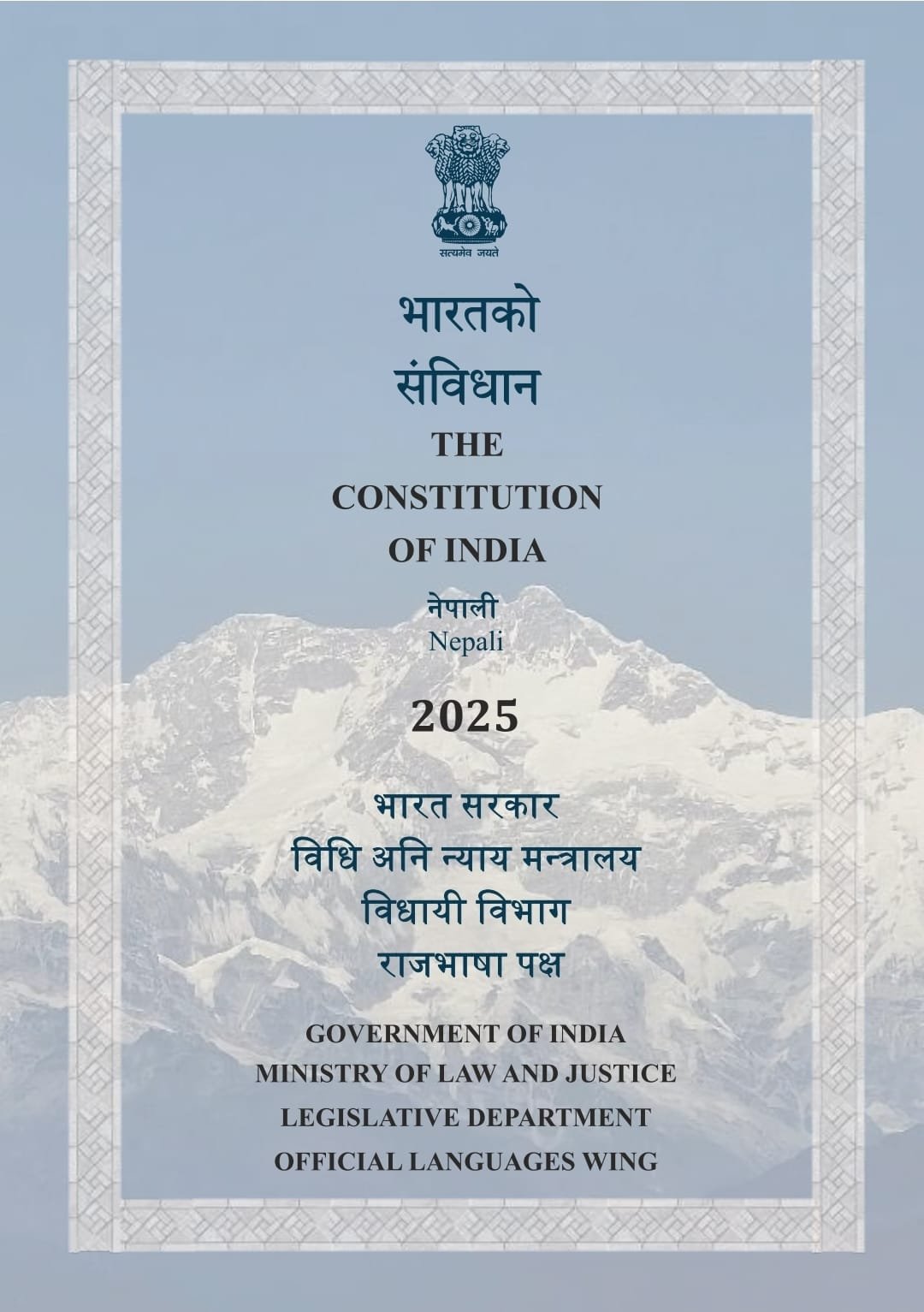
On Constitution Day, November 26, 2025, when President Droupadi Murmu unveiled the Constitution translated into nine Indian languages—including the long-awaited and legally authoritative Nepali edition—it was not just a ceremony. It was a moment of fulfillment, dignity, and deep emotional meaning for millions.
A long journey—rooted in sacrifice, vision, and patience—finally came home.
Part I: The Core Promise — The Idea of India
At Independence, India faced a profound question:
Should unity be built by silencing differences, or by embracing them?
The founders chose the radical and courageous path—the “Idea of India”: a nation where diversity is not tolerated, but honoured. They believed that to protect languages was to protect democracy itself. For them, language was not just grammar—it was memory, culture, identity, and soul of the civilisation.
This philosophy led to one of the most democratic restructurings of a nation in history.
The Linguistic Reorganisation Effort
In 1953, the States Reorganisation Commission, led by Justice Fazal Ali, undertook the complex task of redrawing India’s internal boundaries. Unlike earlier committees that rejected the linguistic argument, this Commission recognised that language was central to identity and governance.
Its recommendations led to the States Reorganisation Act of 1956, shaping states like Andhra Pradesh, Gujarat, Maharashtra, and Karnataka on linguistic lines—without ever surrendering to the extreme idea of one language, one nation and one constitution.
It was a masterstroke of balance, acknowledging linguistic pride while safeguarding minority rights.
Part II: The Struggle for Recognition — Nepali’s Constitutional Journey
For the Nepali-speaking community across Sikkim, Darjeeling, Kalimpong, Assam, Uttaranchal and beyond, this achievement is rooted in decades of commitment. The movement resonated in a simple but powerful declaration:
“भाषा हाम्रो प्राण हो।”— Language is our life.
Honoring the Torchbearers
The history of this recognition cannot be written without reverence for those who lit the path:
Shri Nar Bahadur Bhandari
Former Chief Minister of Sikkim, whose leadership elevated the Nepali language movement to national consciousness.
Smt. Dil Kumari Bhandari
The first and only woman MP from Sikkim and the unyielding architect of parliamentary support. Through persistence and persuasive strength, she marshaled nearly 300 MPs behind the cause.
Their dedication culminated in a historic milestone on August 20, 1992, when the 71st Constitutional Amendment Act officially included Nepali, alongside Konkani and Manipuri, in the Eighth Schedule of the Constitution.
It was not merely a legal achievement—it was a recognition of identity, history, and dignity.
Part III: The Triumph of Accessibility — The 2025 Edition
Recognition in 1992 was victory—but justice demanded accessibility. Earlier translations existed, but as amendments accumulated, they became incomplete. The Constitution must speak to its people clearly, accurately, and legally.
Thus began the scholarly mission of transformation.
For two years (2023–2025), a dedicated team worked through legal nuance, linguistic precision, and philosophical meaning—traveling repeatedly to the National Translation Mission in Mysuru.
Gratitude to Institutions
This historic text was made possible through the stewardship of:
The Parliament of India which not only passed the 71st Amendment in 1992 but also hosted the unveiling in the symbolic Central Hall of Samvidhan Sadan.
The Union Ministry of Law and Justice, specifically, the Legislative Department, which ensured the translation was not only accurate—but legally complete and enforceable.
Honoring the Scholars
We proudly acknowledge the core team from Sikkim whose names now live within the Nepali edition itself:
Dr. Sarda Chhetri
Dr. Uday Chettri
Dr. Bidhan Golay
Dr. Suchan Pradhan
Dr. Krishna Kumar Sapkota
Joining them in this monumental effort was a distinguished cadre of translation and review specialists from across the nation whose scholarship ensured precision, linguistic authenticity, and legal clarity. This esteemed group includes Dr. Anupama Devi of the Gauhati High Court, Guwahati; Dr. Bhabani Prasad Sharma of the University of Bongaigaon; Dr. Dil Kumar Pradhan of Birpara College, Alipurduar; Dr. Dipesh Lama of Government General Degree College, Pedong; Dr. Ghanashyam Nepal (Retd.) of the University of North Bengal, Darjeeling; Dr. Jayanta Krishna Sarmah of Gauhati University, Guwahati; Dr. Kabi Basnet of Darjeeling Government College, Darjeeling; Dr. Khemraj Timsina of the National Translation Mission, Mysuru; Dr. Krishna Maya Manger of the University of North Bengal, Darjeeling; Dr. Padam Nepal of St. Joseph’s College, Darjeeling; Dr. Pamchuila Bhutia of Sonada Degree College, Sonada; Dr. Ritu Chettri of Munshi Premchand Mahavidyalaya, Siliguri; Dr. Shiben Sharma of the University of North Bengal, Darjeeling; Dr. Upendra Adhikari of Kurseong College, Kurseong; Dr. Vinod Pradhan of Southfield College, Darjeeling; and Dr. Yogesh Khati of Kurseong College, Kurseong. Their collective labour, wisdom, and attention to nuance form the scholarly foundation upon which this final, authoritative Nepali edition now stands—an enduring affirmation of knowledge in service of democracy.
Timeline of the Journey
Year/Date Milestone Contributor(s) Significance
1953–1956 State Reorganisation: Fazal Ali Commission Map redrawn based on language; pluralism strengthened.
1985–1992 Renewed movement: N.B. Bhandari & D.K. Bhandari National momentum for Nepali recognition
Aug 20, 1992 71st Amendment: Dil Kumari Bhandari & Parliament Nepali language officially enters Eighth Schedule
2023–2025 Translation Mission: Scholars across regions definitive modern Nepali edition of Constitution prepared.
Nov 26, 2025 Official Unveiling: President Murmu & Law Ministry Constitution becomes fully accessible in Nepali
The Meaning of This Moment
This achievement is not just administrative—it is civilizational.
When the Supreme Law speaks in a people’s mother tongue, democracy deepens. Rights become clearer. Duties become meaningful. Citizens become empowered—not as subjects, but as equals.
This is India fulfilling its founding vow:
Unity in diversity—not in rhetoric, but in reality.
Today, the Constitution in Nepali stands as a affirmation to every student, every elder, every poet, every activist, every leader—and every citizen who believed that identity and nationhood can coexist without conflict.
This is not just a translation—it is inclusion becoming lived truth.
It is history finding closure.
It is the Idea of India—made visible, audible, and beautifully alive.




