

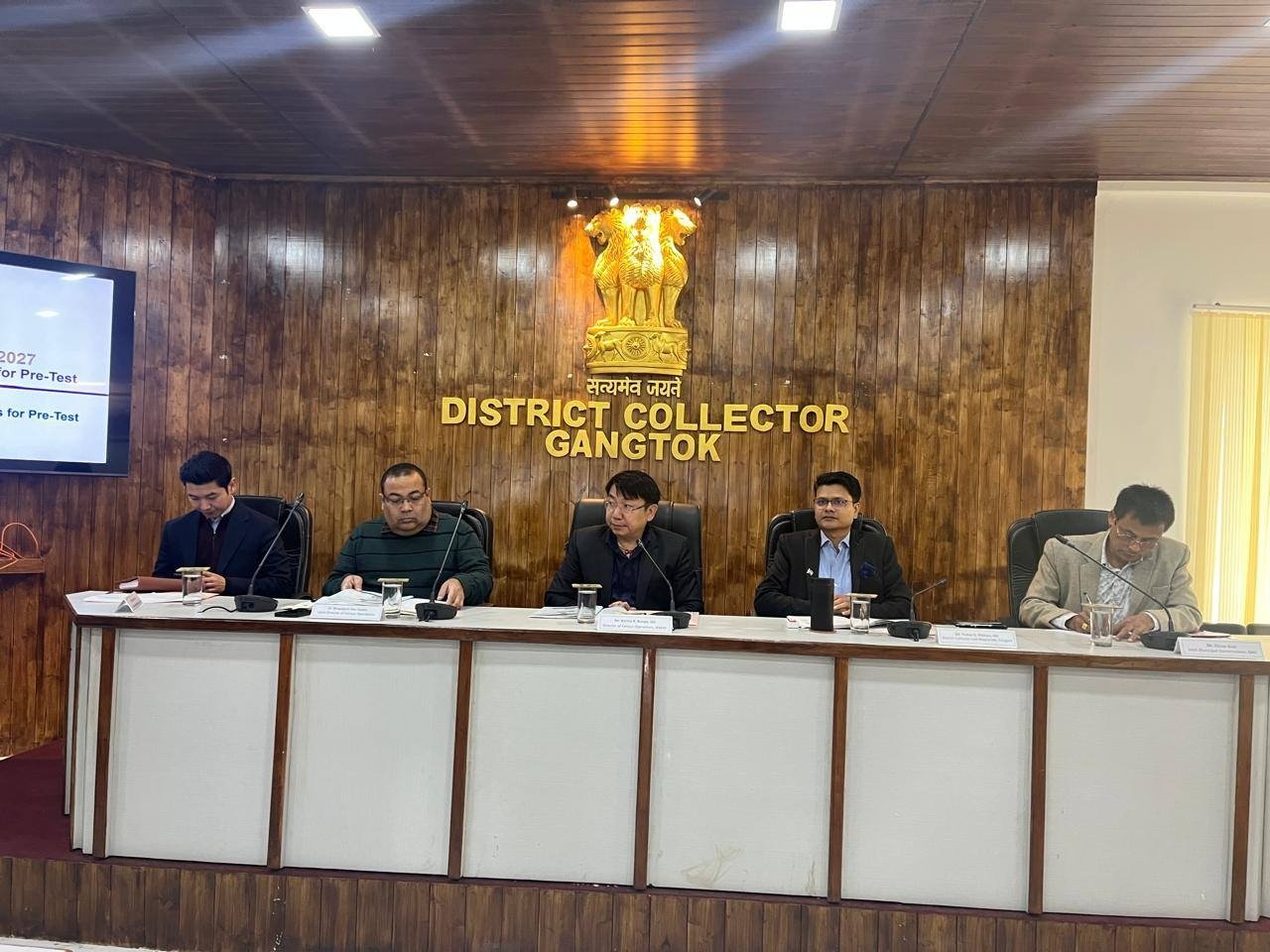

GANGTOK: The first day of the three-day Session Plan for Enumerators and Supervisors’ Training for Census 2027 Phase-I (HLO) Pre-Test was conducted at the Conference Hall of the District Administrative Centre (DAC), Gangtok on Monday.
The training was overseen by the Director of Census Operations, Sikkim, Mr Karma R Bonpo. Also present were the District Magistrate, Gangtok, Mr Tushar Nikhare; ADM, Gangtok, Mr Sisum Wangchuk Bhutia; Joint Municipal Commissioner, GMC, Mr Chiral Rizal; Joint Director of Census Operations, Mr Biswajyoti Das Gupta; SDM, Gangtok, Mr Mahendra Chettri, along with enumerators and supervisors from various departments.
Addressing the participants, Mr Karma R Bonpo stated that the three-day intensive training programme on the upcoming Census holds great significance and urged all participants to take the sessions seriously. He informed that the Census of India, conducted once every decade, had been postponed from 2021 due to the COVID-19 pandemic. Consequently, the forthcoming Census assumes greater importance, as the data collected will serve as a vital reference for policy formulation and developmental planning.
He highlighted that Census data forms the foundation for numerous Central and State Government schemes and policy decisions. Even the Finance Commission relies on population data derived from the Census for the devolution of tax revenues to the States. Hence, he emphasised that accuracy in data collection is of utmost importance, as any inaccuracy or underrepresentation could adversely affect a State’s share of funds, tax revenues, and benefits from welfare schemes.
Mr Bonpo underscored that every Census functionary must ensure the data collected is both accurate and representative. He informed that the training aims to equip enumerators, supervisors, and officers with a thorough understanding of the concepts, procedures, and digital tools involved in the process.
He further explained that the Census will be conducted in two phases and highlighted that this will be India’s first fully digital Census. All data will be collected through a dedicated mobile application, thereby reducing paperwork and minimising post-processing errors. The collected data will be securely uploaded to the central server for faster and safer processing.
Participants, he added, will receive hands-on training in using the digital tools. The ongoing pre-test is designed to identify and resolve technical issues based on field feedback. He directed all functionaries to report any operational or technical difficulties to their designated officers, noting that such feedback would play a vital role in refining the process before the national rollout.
Emphasising data security, he reminded participants that Census data is confidential and protected by law. He advised them not to share passwords, to avoid using official devices for personal purposes, and to ensure that no one else handles Census equipment during the enumeration period.
Clarifying misconceptions, he stated that the Census has no relation to citizenship determination. It is a nationwide exercise to count all individuals residing in the country, regardless of nationality, and contains no questions about citizenship. Questions on caste and social groups, he mentioned, will feature only in the second phase, while the first phase will focus solely on housing and household particulars.
He further informed that comprehensive training manuals and digital modules have been developed by the Office of the Registrar General and Census Commissioner, India (ORGI) to assist participants in understanding the procedures, mobile application, and questionnaires. The app will also record the GPS location of each building to ensure spatial accuracy. He advised enumerators and supervisors to familiarise themselves thoroughly with the app and to adhere strictly to the official guidelines while recording data.
Concluding his address, Mr Bonpo emphasised that the Pre-Test exercise is a crucial preparatory stage to identify and address challenges before the national Census rollout. He encouraged participants to raise queries during the training and expressed gratitude to the District Collector, technical team, and officers involved for their support in organising the programme.
In his address, District Magistrate, Gangtok, Mr Tushar Nikhare, stated that the three-day workshop has been carefully designed to cover all technical aspects of the Census. He said that the data compiled through this exercise would form the cornerstone of future socio-economic and developmental policies.
He noted that this phase marks the first testing stage for the new Census Mobile Application, representing a significant technological advancement. He encouraged trainees to make the most of the workshop by listening attentively, asking questions, and clarifying doubts to better prepare for fieldwork.
Expressing confidence in the participants’ technological aptitude, he said that while initial challenges may arise, the app-based methodology would soon be adopted with ease. Upon completion of the pilot training and field exercises, the participants would serve as trailblazers for the national rollout, he added. He also expressed gratitude that Gangtok had been selected as the pilot district and thanked the Director of Census Operations, Sikkim, for this recognition.
As part of the ongoing three-day training, a series of technical sessions was conducted today to familiarise participants with the digital methodology and tools introduced for the forthcoming Census. The sessions, led by technical experts, covered both conceptual and practical aspects of census operations.
The day began with an Introduction to Digital Census 2027, outlining the transition from traditional manual data collection to a fully digital, app-based system. Participants were briefed on the objectives, key innovations, and advantages of the new approach. Detailed discussions were held on Concepts and Definitions, including location particulars, building and census house identification, household classification, and house numbering. Trainers emphasised the importance of uniformity and accuracy in recording Census particulars.
Further sessions covered the Legal Aspects of Census and the Roles and Responsibilities of Enumerators and Supervisors, sensitising participants to the confidentiality provisions of the Census Act and their accountability in maintaining data integrity.
The training also included an Overview of the Process of HLB (House Listing Block) Boundary Creation by Charge Officers and Supervisors, providing a step-by-step explanation of how boundaries are demarcated and verified prior to enumeration.
The day concluded with a hands-on session on Preparation of Layout Maps using the Digital Layout Mapping (DLM) App, featuring live demonstrations to familiarise participants with its functionalities.
The training team from the Directorate of Census Operations, Sikkim included Mr Tajram Meher, Assistant Director and Lead Trainer; Mr Vimlesh Kumar, Lead Trainer; Mr Pronay Acharyee, Trainer; and Mr P Pratap Singh, Trainer.
The Census Mobile Application has been developed by the Office of the Registrar General and Census Commissioner, India (ORGI) in collaboration with the Centre for Development of Advanced Computing (C-DAC) to enable a more efficient and technology-driven approach to Census data collection.
The training sessions aim to enhance the technical competence of field functionaries and ensure the smooth implementation of the pilot Digital Census 2027 Pre-Test in Gangtok District. Trainers encouraged participants to engage actively, seek clarifications, and build confidence for the upcoming field operations.
- IPR Report



