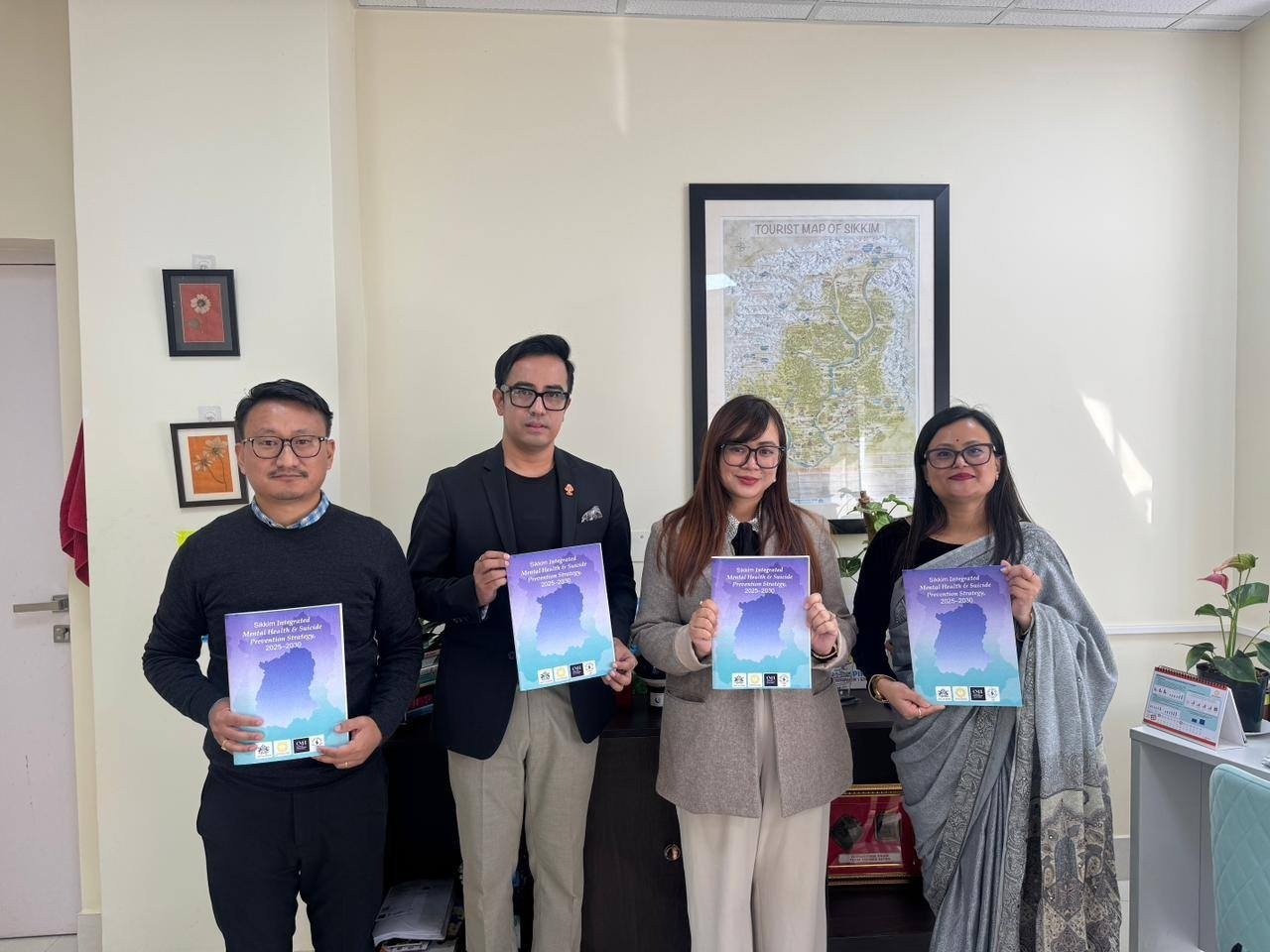

Gangtok, November 19 (IPR): A meeting on mental health, suicide prevention and emerging fertility trends in Sikkim was held today at the office of Sikkim INSPIRES, Tashiling Secretariat.
The meeting had the presence of Program Director, Sikkim INSPIRES, Ms Rohini Pradhan, Press Secretary to the Chief Minister, Mr Yougan Tamang, and Assistant Director, Sikkim INSPIRES, Ms Roshnila Gurung.
The meeting reviewed the Government of Sikkim’s upcoming four-year intervention plan under the Sikkim Integrated Mental Health and Suicide Prevention Strategy 2025–2030, developed with technical support from the Centre for Mental Health Law and Policy. The initiative aims to strengthen community-based care, improve coordination across departments and enhance suicide prevention efforts in all districts.
The strategy includes five major programmes:
- Atmiyata – Community-Based Mental Health and Social Care Model
A people-led initiative to provide free mental health and social support across rural and urban areas. It will be piloted and then scaled up across the state. Studies suggest the programme can reduce the mental health care gap by 30 percent. - Integrated Framework for Suicide Prevention and Response
A system to improve coordination between health workers, communities and law enforcement. It includes developing a multi-level suicide data reporting system, training frontline personnel and scaling up the programme across the state. - Adolescent Mental Health and Suicide Prevention – Family-Focused Approach
Through the Strengthening Families and Youth Nominated Support Team models, this programme will work to improve family relationships and support systems for adolescents. It will begin in Gangtok before expanding statewide. - Public and Media Engagement
A state-wide awareness drive will be launched, along with guidelines for responsible media reporting. The plan includes collaboration with media professionals and social media influencers to promote safe and informed communication. - Support for Young People in Higher Educational Institutions
Colleges will introduce a peer-support model and train faculty as suicide-prevention gatekeepers. The programme aims to cover more than 12,000 students in Sikkim’s public colleges.
Collectively, these efforts aim to promote help-seeking behaviour, strengthen community support and reduce suicide risks across Sikkim.
The meeting also focused on Sikkim’s rapidly falling fertility rate. With one of the lowest Total Fertility Rates (TFR) in the country, the state has seen a drop from 2.75 in 1998–99 to 1.1 in 2019–21, a decline of 129 percent. To address this demographic challenge, the Government of Sikkim has launched several major initiatives:
- Sikkim INSPIRES
A World Bank–assisted programme aimed at improving economic inclusion for women and youth and responding to demographic decline. - Inter-Departmental Working Group
Led by the Planning and Development Department, this group brings together experts from key departments, Sikkim University and Sikkim Manipal Institute of Medical Sciences to study fertility trends and guide policy responses. An expert meeting with ICMR and NIRRCH was held in July 2023 to set research priorities. - Vatsalya Scheme
Launched in 2022, the scheme provides ₹3 lakh to eligible couples facing infertility, including support for IVF treatment, through the Health Department and the Chief Minister’s Medical Assistance Fund. - Mero Rukh Mero Santati
A green initiative that celebrates each newborn by planting 108 trees. It promotes environmental stewardship while supporting family values. Under this, the Sikkim Shishu Samriddhi Yojana deposits Rs 10,800 in the name of each newborn, withdrawable at age 18. - Sikkim Aama Sashaktikaran Yojana
This scheme supports non-working, unmarried, widowed, divorced and separated mothers aged 18–59, offering an annual grant of Rs 20,000 and incentives up to Rs 3 lakh for mothers who successfully double the amount. - Maternity Leave Entitlement Amendment 2022
The amendment extends maternity leave to 12 months and provides one month of paternity leave for government employees.
The Government also announced additional steps to strengthen reproductive health services:
- Advance Increment Incentive:
Government employees will receive one advance increment on the birth of their second child and another for their third child. Either spouse may claim the benefit. - One-Year Fertility Research Study:
An ongoing study by ICMR-NIRRCH aims to identify the factors behind declining fertility and assess the preparedness of the state’s health system. - Impact Assessment of Vatsalya Scheme:
An independent evaluation has been completed to strengthen the scheme’s design and effectiveness. - Establishment of a State-of-the-Art ART Facility:
The Government is setting up an Assisted Reproductive Technology centre offering IVF, IUI and related treatments at affordable rates. INSPIRES has supported MoUs with AIIMS and the Army Research and Referral Hospital for training and capacity building. A partnership with WHO India has also been formed to improve public awareness on reproductive health.
The meeting concluded on a constructive note with detailed discussions on the various initiatives undertaken by the Government. - IPR Report