

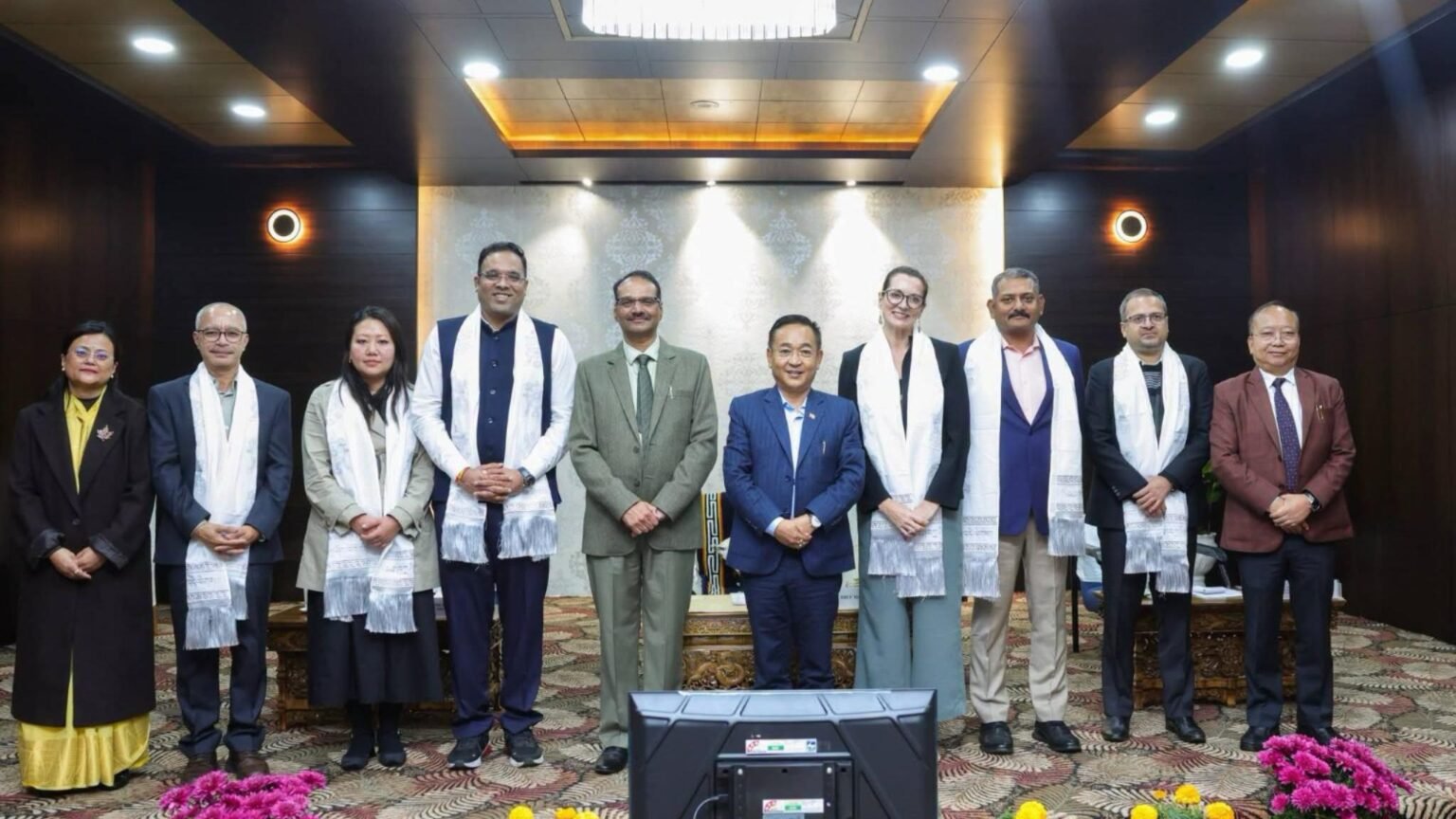

GANGTOK: Chief Minister Prem Singh Tamang today attended the mid-term review meeting of Sikkim INSPIRES (Integrated Service Provision and Innovation for Reviving Economies), a World Bank-supported programme, at Samman Bhawan, Gangtok. The meeting reviewed the programme’s progress, implementation challenges and priorities for the remaining period, with a focus on strengthening institutional mechanisms and translating targets into measurable economic outcomes for the people of Sikkim.
In his address, Chief Minister Prem Singh Tamang called for renewed coordination among departments to accelerate implementation and ensure that the programme delivers tangible benefits to the people. He described Sikkim INSPIRES as an important component of the State Government’s vision of a developed and prosperous Sikkim, emphasising that educational progress must translate into practical skills, sustainable employment and improved household incomes.
Highlighting the Government’s initiatives to promote employment and entrepreneurship, the Chief Minister referred to One Family One Job, the Chief Minister’s Entrepreneurship Initiative, the Aama Scheme, support for self-help groups and homestay initiatives. He also underscored the potential of creative industries, tourism and emerging technologies, announcing support through innovation hubs and acceleration centres to encourage entrepreneurship and enterprise development.
The Chief Minister further highlighted plans to establish Career Counselling, Training, Employment and Entrepreneurship Institutes in every district to enable young people to access guidance, training and career opportunities closer to home. Acknowledging delays in the preparation of district-level plans, he expressed confidence that implementation would gain momentum and that the remaining programme targets would be achieved within the stipulated period.
Emphasising that the success of Sikkim INSPIRES must be reflected in improved livelihoods, increased household incomes and greater economic independence for women and youth rather than merely in reports and targets, he called for aligning the programme’s outcomes with the State’s Vision 2047. He reiterated the Government’s commitment to the principles of a whole-of-government approach.
The Chief Minister also expressed gratitude to the World Bank, the Independent Verification Agency, senior government officials, implementing departments and all stakeholders for their continued support and contribution towards the programme.
Earlier the meeting commenced with a context-setting presentation by Programme Director, Sikkim INSPIRES, Ms Rohini Pradhan.
The Programme Director subsequently presented the programme-level progress report, outlining achievements across its key development objectives, followed by observations and expectations from the World Bank team.
In his opening remarks the Chief Secretary cum Chairman of the Programme Governance Committee, Mr R Telang emphasised the importance of coordinated governance and institutional strengthening to ensure sustainable employment and entrepreneurship opportunities for the youth and women of the State. He highlighted that, under the vision of the Chief Minister, Sikkim INSPIRES had adopted a whole-of-government approach, bringing together multiple departments to create an enabling ecosystem for entrepreneurship, skill development and sustainable livelihoods.
Stressing accountability and outcome-based implementation, he said the programme’s targets were being assessed through independent third-party verification to ensure objective measurement of progress. He observed that development must move beyond physical infrastructure towards building strong institutions and sustainable livelihood opportunities. He further called for a change in mindset among officials and the public, emphasising the need to explore employment and entrepreneurial avenues beyond conventional government jobs in pursuit of the vision of Viksit Sikkim 2047.
Presenting the programme’s mid-term progress, Ms Rohini Pradhan informed that all 10 legal covenants had been fulfilled and 21 of the 50 Disbursement-Linked Results (DLRs), representing 42 per cent of the total targets, had been achieved. All six Year Zero prior results and five Year One targets had been completed, while seven of the 11 Year Two targets had been achieved. She also informed that eight of the 12 Programme Action Plan requirements had been completed, with two targets originally scheduled for Year Five achieved ahead of time.
Outlining the programme’s four development objectives, she highlighted ongoing efforts to strengthen employment opportunities for youth and women, promote entrepreneurship, align skill development with market requirements and improve workplace safety and care systems. She acknowledged implementation challenges across districts and departments but expressed confidence that the remaining Year Two targets would be achieved in the coming months.
Highlighting priorities for the remaining two-and-a-half years, she stressed the need to accelerate ground-level implementation, ensure timely fund disbursement, strengthen cross-cutting areas such as mental health and care infrastructure, and operationalise the Employment and Entrepreneurship Promotion Facility (EEPF) as a sustainable institutional mechanism beyond 2029. She also underlined the importance of strengthening existing government systems to ensure continuity of the programme’s outcomes beyond its implementation period.
World Bank Team Lead Ms Verena Phipps commended the Government of Sikkim for keeping the programme on schedule at its mid-term stage, noting that only 18 per cent of World Bank-financed operations globally conduct mid-term reviews on time. She observed that Sikkim INSPIRES had evolved from an ambitious concept into a coordinated whole-of-government platform, bringing multiple departments together to expand economic opportunities for women and youth across all six districts.
Acknowledging progress in institutional development, entrepreneurship support and inter-departmental coordination, Ms Phipps stressed that the focus during the remaining implementation period must shift towards measurable outcomes, particularly employment generation, job retention and enterprise growth. She also emphasised the importance of strengthening community outreach, mobilising private investment, expanding the care economy and ensuring long-term institutional sustainability. She observed that the programme’s core design required further strengthening rather than restructuring and expressed confidence that continued collaboration between the World Bank and the State Government would help translate the initiative into lasting economic benefits, positioning Sikkim as a model for other States.
The meeting concluded with a vote of thanks by Joint Secretary cum Deputy Programme Director Sikkim Inspires Mr Swabhaw Gurung.
The meeting had the presence of Additional Chief Secretary Cum PCCF Forest & Environment Department Dr Pradeep Kumar, HODs of all 8 priority departments, representatives from World Bank, IVA IIM Kozikode, PMC,EEPF along with senior officials from the Government of Sikkim.
- IPR Report




