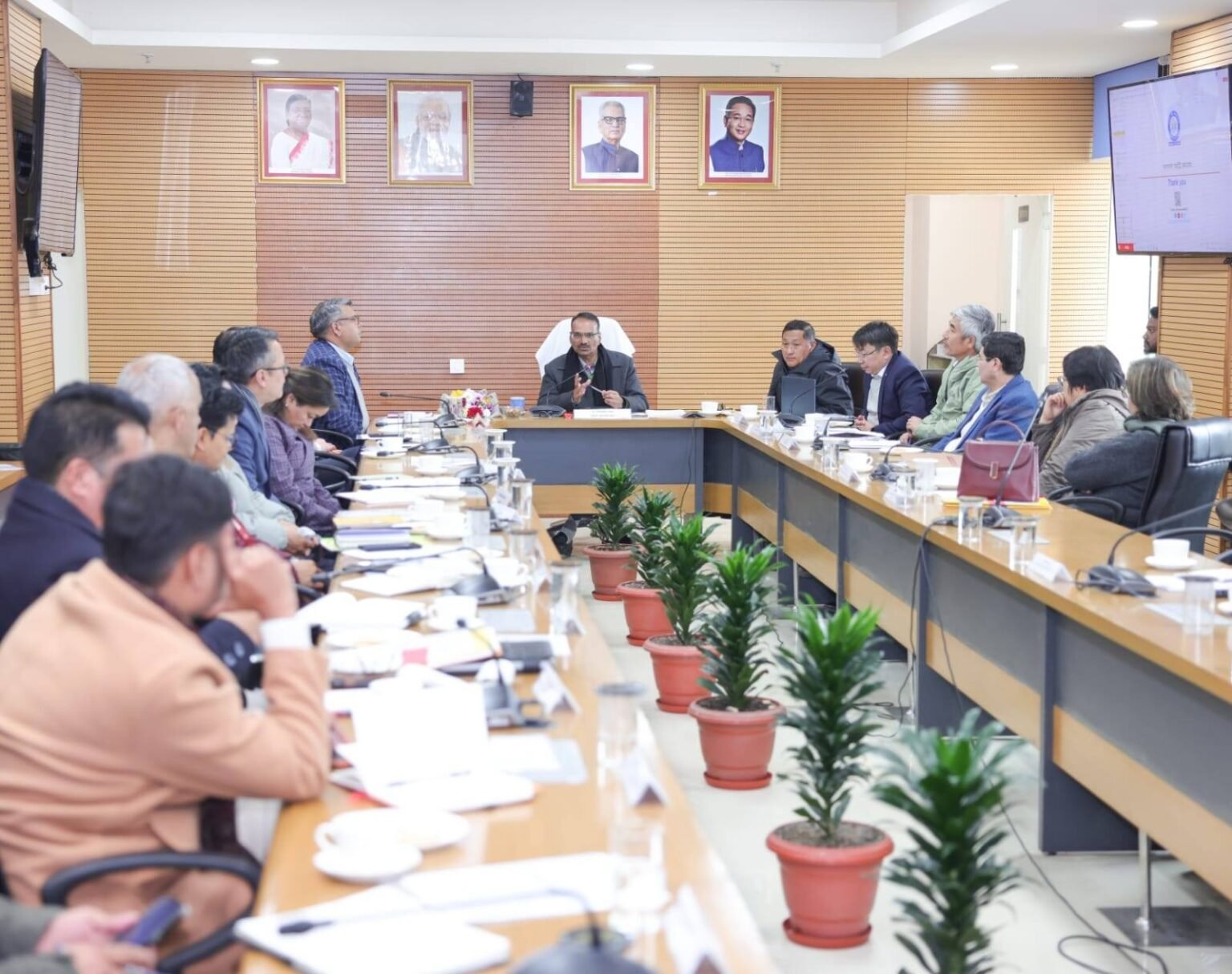

Gangtok, February 7 (IPR): Chief Secretary, Government of Sikkim, Mr R. Telang, IAS, chaired a State-level meeting on Census 2027 at the conference hall of Tashiling Secretariat today.
The meeting was attended by Secretary, Home Department-cum-State Nodal Officer for Census, Mr Tenzing T. Kaleon, Director of Census, Mr Karma R. Bonpo, Heads of Departments from various line departments, District Collectors of all six districts, Additional District Collectors, Sub Divisional Magistrates, Principal Census Officers, officers from the Directorate of Census, Government of Sikkim, and officials from various departments.
Addressing the meeting, Chief Secretary, Mr R. Telang, stressed that cooperation between the State Government and district administration is vital for building public confidence. He added that public trust plays a key role in encouraging citizens to willingly provide accurate information. He further stated that stakeholders at the district level, including cultural and community organisations, should be involved in awareness generation.
Highlighting the advantages of self enumeration, he said that it would reduce the workload of enumerators, improve data accuracy, and enable faster compilation of Census results. He added that government employees may also avail themselves of the self enumeration facility, which has been aligned with the Census schedule.
Emphasising the role of district administration, the Chief Secretary said that effective supervision by District Collectors is crucial to ensure high quality data. He stated that even minimal supervision through weekly monitoring meetings would significantly improve data quality. He further stressed the importance of comprehensive training for enumerators and supervisors, as the success of Census operations ultimately depends on field level execution.
Earlier, Secretary, Home Department-cum-State Nodal Officer for Census, Mr Tenzing T. Kaleon, stated that the meeting was convened to deliberate on the modalities and procedures for conducting Census 2027. He informed that the Census will be conducted entirely in digital mode using mobile based applications and, for the first time, will include the provision for self enumeration. He further informed that the self enumeration process will commence from 1 April. Considering the limited time available, he urged all concerned officials to prepare promptly for this important national exercise.
Director of Census, Mr Karma R. Bonpo, stated that although Census is a subject under the Union List, its conduct requires active participation of both the Central and State Governments, reflecting the federal structure of India. He said that the Census is conducted on a collaborative basis and the data generated is shared not only with the Centre but also with States and other agencies for developmental planning and policy formulation. He informed that the Census is undertaken every ten years. However, the 2021 Census could not be conducted due to the COVID 19 pandemic. Consequently, the forthcoming Census will be conducted after a gap of nearly 16 to 17 years, making it especially significant.
Highlighting the importance of the Census, he stated that population data plays a crucial role in determining political representation in Parliament and State Legislative Assemblies. He further said that the allocation of funds and resources by the Finance Commission and various Government of India schemes is largely based on Census data, making it imperative to ensure accurate and reliable data collection.
He also emphasised that Census data holds historical value as it reflects progress across various socio economic indicators over time and serves as an important resource for research and documentation. He stated that Census 2027 will be entirely digital, enabling faster data processing and timely availability of results. He mentioned that unlike earlier censuses, where data compilation took more than a year, the digital format is expected to make data available within four to five months. He added that the upcoming Census assumes added importance as it will be followed by the delimitation exercise, making the accuracy of data even more critical.
A presentation on “Strategy for Census 2027 – Period, Process, Questions, Overview of Digital Tools, Progress of Work in Sikkim and Inter agency Coordination and Publicity” was delivered during the meeting. The Director of Census highlighted the importance of public cooperation and trust in ensuring the success of the exercise. He said that concerns regarding privacy and sharing of personal information may affect data collection. While the Census Act provides a legal framework, greater emphasis must be placed on coordination and support from various agencies at the ground level.
He stated that most preparatory fieldwork for Census operations has already been completed and the State is largely ready, subject to formal legal notification. Household Listing Blocks have been created and estimation work carried out by incorporating population data from Census 2011 and verifying it with Panchayat records. The data will now be routed through the portal. Maps will then be generated for field operations and enumerators will visit the mapped locations to capture the required data. He noted that while preparations at the administrative level are nearly complete, the actual work will be carried out by enumerators and supervisors, and any gap at that level could affect the outcome. He therefore urged District Collectors to actively monitor and guide field staff.
He also highlighted the long term utility of Census data for district administration, particularly for young officers and Sub Divisional Magistrates. He stated that accurate population data would facilitate better governance by providing insights into population distribution, sanitation conditions, and other socio economic indicators, thereby aiding future planning and implementation of government schemes.
Furthermore, a PowerPoint presentation on self enumeration and monitoring through the CMMS Portal was also presented.
The Director of Census concluded the meeting by reiterating that public awareness, institutional coordination and effective use of digital platforms are essential for the smooth conduct of Census operations and for ensuring the collection of reliable and high quality data. He thanked all participants for their cooperation and valuable inputs during the deliberations.
- IPR Report