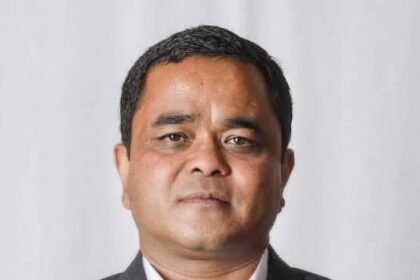
GANGTOK: Chief Secretary R. Telang, chaired a high-level coordination meeting to review the preparedness and ongoing measures for mitigating the risks associated with potential Glacial Lake Outburst Floods (GLOFs) in the State, at the Conference Hall, Tashiling Secretariat on September 10.
The meeting brought together concerned State departments, central agencies, defence organisations, technical institutions and project developers to review ongoing scientific assessments, early warning mechanisms, mitigation measures and inter-agency coordination for strengthening GLOF preparedness in Sikkim.
The Department of Science and Technology, in its presentation, highlighted the significant losses incurred by the State Government during the 2023 South Lhonak Lake GLOF and outlined the Government’s vision and priorities for strengthening preparedness against future glacial flood events. These include establishing and strengthening early warning systems, developing resilient infrastructure, protecting critical mountain infrastructure such as roads, dams, bridges and habitations, preparing site-specific GLOF mitigation proposals, and strengthening Sikkim’s leadership in glacial hazard risk mitigation.
Presenting the baseline status prior to the ongoing initiatives, the department highlighted glacial hazard assessment studies and preparedness measures undertaken by the Sikkim State Disaster Management Authority (SSDMA). It also identified key challenges including the absence of standardised protocols for scientific hazard and risk assessments, gaps in specialised mitigation expertise, and sensitivities among local communities concerning scientific studies around sacred glacial lakes.
The department further highlighted the interdisciplinary studies undertaken to integrate science and technology into GLOF risk mitigation. These include hydrometeorological assessments, Electrical Resistivity Tomography (ERT), bathymetric investigations, hydrological and geological studies, and UAV-based terrain mapping.
The presentation also outlined several action-oriented initiatives, including the standardisation of scientific protocols for assessing lake volume, mass movement, hazards and moraine stability through the integration of interdisciplinary studies; development of capabilities in hydrodynamic modelling using HEC-RAS to assess flood-flow paths; refinement of GLOF propagation scenarios; and preparation of structural mitigation proposals.
The department further highlighted policy and institutional measures, including the adoption of a Whole-of-Government Approach, greater clarity in business rules, strengthening of technical expertise, and the proposed establishment of a commission on glacial hazards.
Various approaches for lake-level lowering were also presented, including siphoning, pumping, enhancement of existing channels, construction of artificial open channels, moraine cutting with safety walls, and tunnelling. The department outlined a four-step approach to GLOF risk mitigation comprising preliminary assessment, comprehensive assessment, design of mitigation measures, and execution and monitoring of mitigation measures.
Key scientific and technical methodologies highlighted during the presentation included bathymetry, moraine stability assessment, debris-deposition analysis, hydrological assessment, hydrodynamic modelling and high-altitude field operations. The department also highlighted the establishment of Automated Weather Stations (AWS), monitoring stations and lake-water-level monitoring systems at Shako Chho and South Lhonak lakes.
Regarding Shako Chho Lake, the department stated that it is among the 16 Category A high-risk glacial lakes identified in Sikkim. The lake has no natural outlet and is characterised by an unstable, triangular-shaped configuration, a permeable moraine dam and a low width-to-height ratio.
The nearest habitation, Thangu village, is located approximately 13 km downstream of the lake, making timely intervention particularly important. The department presented findings and recommendations from various agencies, along with estimates of the lake’s bathymetric depth and volume.
As part of the option analysis, solar-powered pumps have been identified as a practical intervention for lowering the lake level. Structural intervention is not considered advisable, while a siphon system has been assessed as unfeasible due to the lift head exceeding 20 metres. The department also presented the tentative layout of the proposed solar pumping system and the safeguards incorporated into the proposal.
Regarding the Gurudongmar Complex, the department stated that a moraine plug-wall mitigation strategy has been proposed. The Department of Science and Technology, in collaboration with the Brahmaputra Board, is developing the proposal with the objective of mitigating GLOF risk while preserving the cultural and religious sanctity and significance associated with the lake.
Regarding the Lhonak Complex, the department informed that a Preliminary Project Report (PPR) has been submitted to the Ministry of Jal Shakti. The Central Water Commission (CWC), in collaboration with the Department of Science and Technology, Government of Sikkim, is working on a Detailed Project Report (DPR) for a flood-retention structure at Dolma Sampa near Muguthang in the Lhonak Complex.
Jumthul Phuk Glacial Lake was also highlighted as an emerging glacial hazard in the State, owing to its significant and continuous expansion over the past three decades.
The Central Water Commission, Investigation Circle, Gangtok, in its presentation on GLOF Preparedness and Monitoring, provided an overview of the GLOF-related activities being undertaken by the Commission. The presentation covered monitoring of glacial lakes and water bodies, flow-path mapping, and the proposed score-based classification criteria for assessing the risk index of glacial lakes. It also highlighted GLOF studies undertaken in Sikkim and studies conducted by CWC for Hydro Electric Power (HEP) projects.
The presentation further covered the installation of Early Warning Systems (EWS) at priority lakes, preparation of the DPR for GLOF risk mitigation in the Lhonak Valley, Sikkim, and updates on the 2nd Meeting of the Working Group held on August 18, 2026. The functioning and objectives of the Flood Crisis Management Team (FCMT), including its first meeting, were also discussed. Other aspects covered included river training works under deposit work, HO stations in Sikkim, hydrological monitoring, the telemetry network, the flood forecasting system in Sikkim, and warning dissemination and coordination with State agencies.
The Geological Survey of India (GSI), in its presentation on the Comprehensive Multi-Hazard Risk Analysis along the Teesta River from Zema to Meli, presented assessments of flood dynamics, including GLOF-related hazards, along the Teesta River. The presentation also covered slope stability conditions along the river corridor and seismic vulnerability assessments. These assessments were integrated into a comprehensive multi-hazard risk analysis, along with corresponding mitigation strategies to address the identified risks and vulnerabilities along the Teesta River.
National Hydroelectric Power Corporation Limited (NHPC), in its presentation on GLOF Preparedness, Risk Assessment and Early Warning System, provided an overview of the Teesta Basin and the Early Warning Systems established at NHPC projects and power stations within the Teesta and Rangit River Basins. The presentation outlined various mitigation measures and strategies adopted for monitoring, modelling and management of GLOF risks. It also highlighted the E-AABHAS Portal, which includes HEPs in Sikkim, except Teesta-III and Madhya Bharat, within the Teesta River Basin, as part of efforts to strengthen GLOF preparedness, risk assessment, monitoring and early warning mechanisms.
Greenko, in its presentation on Preparedness for GLOF, provided an overview of the Teesta III HEP (1,200 MW) and presented the restoration proposal, including the project layout for Part-I and Part-II restoration works. The presentation further detailed the Part-I works and preparedness measures undertaken for GLOF risk management, with particular emphasis on the discharge capacity of the cofferdam and reservoir management.
The presentation also covered the monitoring, inspection and evaluation framework, including the locations of Early Warning System stations, operational safety under Part-I works, reservoir flood-passing arrangements and additional safety measures adopted as part of the overall GLOF preparedness strategy. It concluded with a site view of the cofferdam, providing an overview of the restoration and safety measures being undertaken at the project site.
Relief Commissioner-cum-Secretary, Land Revenue and Disaster Management Department, Mr Rinzing Chewang Bhutia, highlighted the disaster preparedness and risk reduction measures being undertaken by the Sikkim State Disaster Management Authority (SSDMA). He informed that community sensitisation programmes have been conducted in vulnerable areas and vulnerability maps have been prepared to support preparedness and response planning. He emphasised the importance of further strengthening community-level awareness and sensitisation, particularly in vulnerable locations, to ensure that local communities are adequately informed about risks, early warnings and appropriate response measures.
Professors from Sikkim University highlighted the importance of strengthening scientific assessments of glacial and slope-related hazards. They emphasised the need to study slope deformation as an indicator for identifying potential GLOF-related risks and called for the periodic reassessment of the 16 Category A high-risk glacial lakes using updated and high-resolution datasets.
They further highlighted the need for high-resolution ground data to strengthen floodplain zoning and risk mapping, greater use of drone-based data collection along valley corridors, and the integration of debris-flow and hyper-concentrated-flow modelling with conventional clean-water flood-flow modelling. These inputs were emphasised as important for developing a more comprehensive understanding of downstream hazard propagation and strengthening mitigation and preparedness measures.
Chief Secretary R. Telang, stressed the importance of ensuring that Early Warning Systems are efficient, reliable and capable of disseminating alerts at the earliest possible stage to enable timely action by authorities and communities. He emphasised the need for regular mock exercises and preparedness drills to strengthen institutional coordination, response capacity and community readiness in the event of a GLOF or other related disaster.
The Chief Secretary also reviewed the inputs presented by the participating departments and agencies and provided suggestions to the concerned line departments for strengthening coordination, preparedness, monitoring and mitigation measures. He underscored the importance of maintaining close coordination among scientific institutions, technical agencies, State departments, project developers, defence organisations and local administrations in addressing the evolving risks associated with glacial hazards.
The vote of thanks was proposed by Principal Secretary, Department of Science and Technology and Education Department, Dr Sandeep Tambe.
The meeting was attended by GOC,27 Mountain Division, Mr Rajesh Misra; Secretary, Home Department, Mr Tenzing T. Kaleon; Secretary, Information and Public Relations Department, Ms Annapurna Alley; Secretary, Department of Mines and Geology, Ms Dicky Yangzom; Secretary, Power Department, Mr Bikash Deokota; Secretary (IPP), Power Department, Mr S.R. Bhutia; Secretary, Department of Science and Technology, Mr Dhirendra G. Shrestha; Secretary, Water Resources Department, Mr L.D. Lamtha; Secretary, Roads and Bridges Department, Mr A.B. Subba; IGP, Sikkim Police, Mr Hari Chettri; and senior officials from BRO, ITBP, 27 Mountain Division
and various line departments and agencies.
- IPR Report